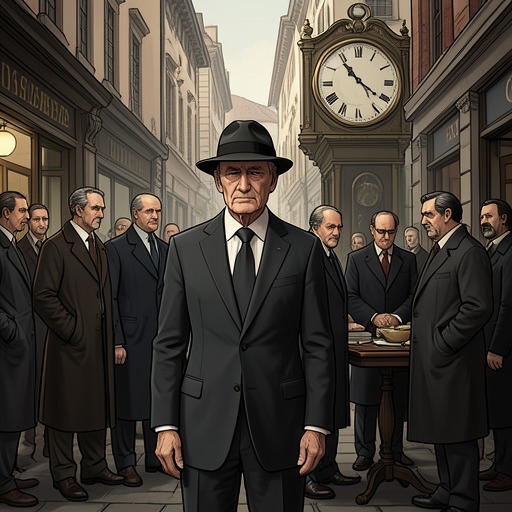
Peter Clemenza
The GodfatherPeter Clemenza is one of the Corleone Family’s most experienced and consequential lieutenants, a man who joins jovial sociability to organizational discipline and lethal efficiency. He first appears as a huge, exuberant figure at Constanzia Corleone’s wedding, dancing the Tarantella with such skill and abandon that the guests applaud him, yet he is also the superior who sends Paulie Gatto away from the festivities to inspect the neighborhood. Across the story, Clemenza becomes the practical executor of Vito Corleone’s system and later one of the men who secures Michael Corleone’s victory.
Identity and Introduction
Clemenza is Peter Clemenza, a senior captain of the Corleone Family and the boss of Paulie Gatto. At the wedding, his physical size is inseparable from his social presence: he is immensely tall and huge, with a hard belly, but he dances with enough skill and abandon to draw both young and older women onto the floor. The scene presents him as a figure welcomed by the community rather than merely feared by it. The younger men respectfully make room, the women compete to dance with him, and Paulie attends to him by bringing black wine and wiping his brow with a silk handkerchief. Clemenza’s authority, however, is visible beneath the celebration. When Paulie behaves like a spectator instead of an employee, Clemenza curtly orders him to stop judging the dancing and walk around the neighborhood to make sure everything is secure. The command turns a wedding party into a controlled Family environment: hospitality, pleasure, and surveillance operate together.
Early Bond with Vito Corleone
Clemenza’s relationship with Vito Corleone reaches back to Vito’s youth, when both men lived in the same immigrant neighborhood. In one decisive early encounter, Clemenza appeared at Vito’s window across an open air shaft and urgently handed him a white-sheeted bundle. Vito instinctively helped before knowing what he had accepted; when he opened the bundle, he found five guns inside. Clemenza had been taken away by the police, and Vito concealed the weapons in his bedroom closet. Vito never spoke of the guns, while Clemenza’s wife was too frightened to discuss the matter. When Clemenza returned two days later and casually asked whether Vito still had his goods, the episode established the basis of their later association: Vito’s silence and Clemenza’s trust were not abstract virtues but practical acts that created obligation. The later Corleone system of friendship, service, and repayment grew from precisely such exchanges, in which protection depended on discretion and loyalty.
Role in the Family’s Organization
As Vito’s enterprise expanded, Clemenza became one of two caporegimes, or captains, alongside Salvatore Tessio. The Family’s growth required more than personal allegiance, so Vito divided authority among captains and soldiers, assigned Tessio responsibility for Brooklyn, and kept Clemenza’s Bronx operations under closer supervision. Vito regarded Clemenza as brave, reckless, and cruel beneath his outward good humor; the tighter rein was therefore a security measure, not a sign of personal hostility. Clemenza’s position also illustrates how Vito converted personal rule into an insulated hierarchy. Orders moved through selected intermediaries rather than directly from the Don to the men who performed the violence. The same structure later appears when Vito gives instructions privately to Tom Hagen, Hagen passes them to Clemenza, and Clemenza tells Paulie Gatto to carry them out. Paulie and his men need not know the original purpose or source of the order. Clemenza is therefore both a trusted subordinate and a buffer protecting Vito from operational exposure. His authority rests on several overlapping forms of legitimacy. He belongs to the old neighborhood network, commands respect through rank and experience, and possesses the capacity for violence, but his effectiveness also depends on procedure: assigning tasks, choosing personnel, and preserving the separation between policy and execution. In this sense, Clemenza is a bridge between the Godfather’s personal authority and the Family’s increasingly bureaucratic machinery.
Paulie Gatto and the Discipline of Betrayal
When Santino Corleone orders Paulie Gatto dealt with immediately, Clemenza treats the assignment as both a security necessity and a personal reckoning. Paulie had once been his protege. Clemenza had advanced him over more deserving and loyal men, helped him make his bones, and supported his career. Paulie’s betrayal therefore violated two bonds at once: his obligation to the Family and his debt to his padrone. Clemenza’s deliberation over the personnel for the job reveals his administrative judgment. He selects Rocco Lampone, a young man who had been wounded in Africa during the war and walked with a pronounced limp, but whose work as a black-market contact and troubleshooter had demonstrated sound judgment. Clemenza values Lampone because he knows when heavy threats are unnecessary and can keep an operation in a minor key. The assignment will allow Lampone to make his bones while permitting Clemenza to settle his own score. Clemenza arranges the operation with exactness. Paulie is told to pick him up at three in the afternoon in Paulie’s own car, with nothing stolen or otherwise conspicuous about it. Clemenza alerts the necessary personnel and ensures that replacements are ready for the affected territory. His violence is never detached from logistics: the murder is planned as an administrative correction within a living organization.
Relationship to Vito and the Succession Crisis
Clemenza’s loyalty to Vito is part of the larger economy of respect that sustains the Corleone Family. Vito helps people who proclaim friendship, accepts modest gifts as signs that a debt exists, and creates a world in which service can later be called in. Clemenza participates in this system both as beneficiary and enforcer. His early concealment of the guns binds him to Vito, while his later rank confirms that loyalty can be converted into wealth, authority, and lasting position. After Vito’s semi-retirement and Michael’s takeover, Clemenza attends the tense leadership meeting with Michael, Tom Hagen, Carlo Rizzi, and Tessio. The succession is not automatically hereditary: powerful caporegimes could, in another Family, become independent chiefs or divide away. Clemenza therefore represents a potential alternative center of power, even though the narrative shows him remaining within Michael’s structure. The circumstances make his continued cooperation significant. The Corleone Family has weakened after the peace with the Five Families; the Barzini Family, allied with the Tattaglia Family, has entered Corleone gambling territories and established bookmakers after finding little resistance. Vito’s failure to avenge Santino Corleone’s death has also damaged the Family’s reputation. Clemenza sits inside this declining order as an experienced captain whose loyalty must be maintained rather than simply presumed.
Violence, Victory, and Later Position
Clemenza’s most intimate act of violence comes in the killing of Carlo Rizzi. After Carlo is lured out under the pretext that Michael will send him to the airport, Clemenza sits in the back of Carlo’s car and strangles him with a garrote. The method is quiet, controlled, and final: he keeps the rope tight for several minutes after Carlo’s body goes slack, then releases it and lowers the window to clear the foul air from the vehicle. The killing is not an isolated revenge. During the same twenty-four-hour period, Clemenza and Rocco Lampone release their regimes against infiltrators in Corleone territory. Barzini bookmakers are put out of business, senior Barzini enforcers are shot while eating in an Italian restaurant, a race fixer is killed after returning from the track, and major waterfront shylocks disappear. Clemenza thus functions as one of the principal instruments through which Michael’s purge becomes a coordinated seizure of power. A year later, after twelve months of political maneuvering, Michael has become the most powerful Family chief in the United States. The Corleone Family is unchallengeable, and Clemenza has his own Family, while Rocco Lampone serves as Michael’s caporegime and Albert Neri commands security for the Family-controlled hotels in Nevada. Clemenza’s final position confirms both his success and the system’s transformation: he no longer merely serves as one captain inside Vito’s neighborhood empire but presides over an independent Family produced by the Corleone victory.
Narrative Significance
Clemenza is built around a productive contrast between abundance and control. His dancing, enormous body, appetite, and easy familiarity make him appear almost comic at first, yet those qualities coexist with a precise understanding of rank, secrecy, and consequence. He can command a patrol in the middle of a wedding, select a subordinate according to operational judgment, and carry out a strangling without hesitation. His career also demonstrates that the Corleone order is sustained by more than fear. Clemenza’s authority emerges from old friendship, accumulated service, neighborhood recognition, formal rank, and the expectation that betrayal will be repaid. Vito’s system turns personal loyalty into organization; Clemenza is one of the men through whom that conversion becomes visible. His later survival and elevation show that the Family’s violence is not merely destructive. It is also a method of succession, territorial defense, and institutional continuity.